What is KubeAtlas
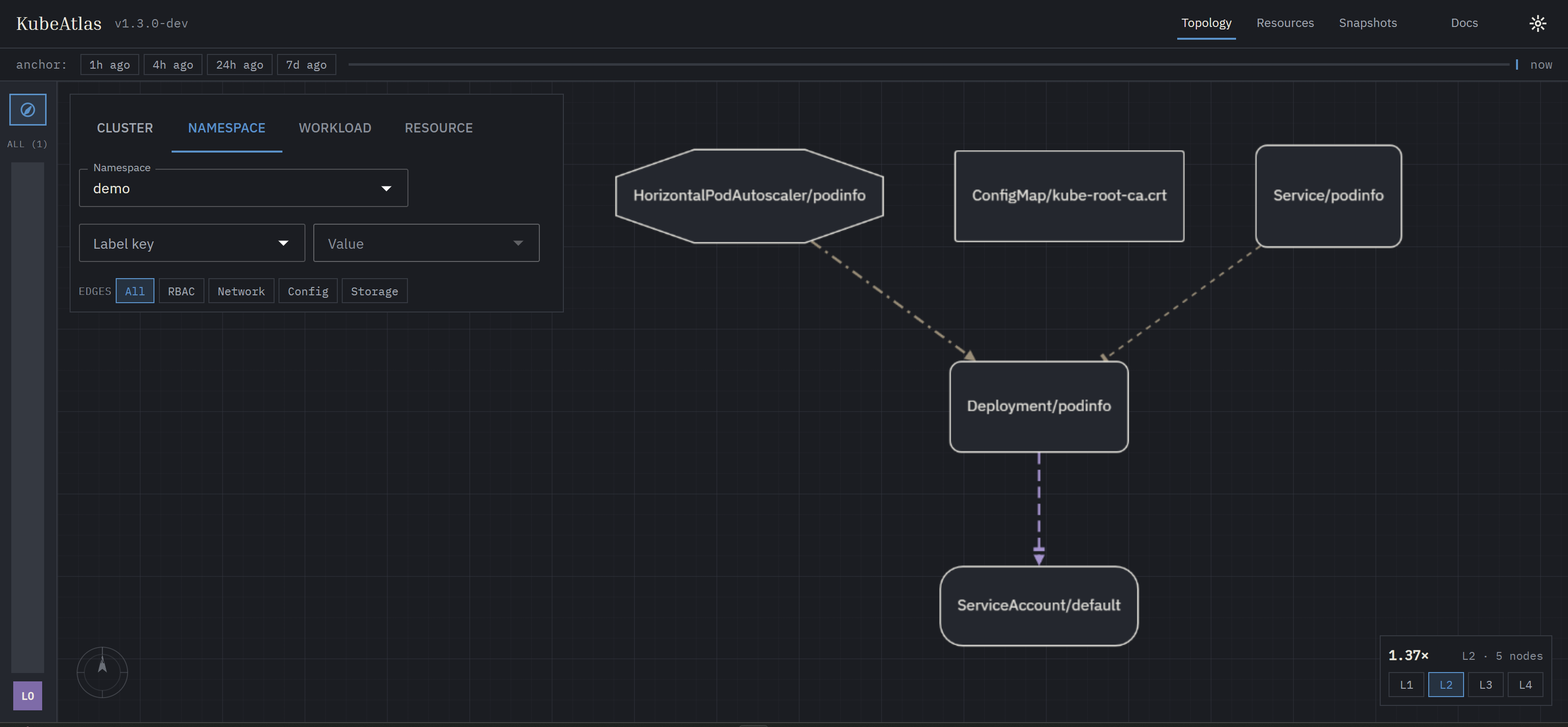
KubeAtlas builds a directed dependency graph of every resource in a
Kubernetes cluster — Deployments, ConfigMaps, Services, Ingresses,
Gateways, HTTPRoutes, PVCs, RBAC, CRDs — and lets you query it. It
answers the questions a flat kubectl get view cannot:
- "If I delete this Secret, what breaks?"
- "Which Deployments mount this ConfigMap?"
- "What's the routing path from this Ingress to a Pod?"
What it is not
- A general-purpose Kubernetes UI. Use Headlamp or Lens for that.
- A monitoring tool. Use Prometheus, Datadog, or your APM of choice.
- A GitOps tool. Use Argo CD or Flux.
KubeAtlas is the dependency graph: a focused view that complements the tools above instead of replacing them.
Project status
v1.3.1 — federation cluster picker wired to the topology
canvas, keyboard graph traversal, drag-anchor time-axis rail,
radial menu for blast-radius depth, screen-reader announcements,
Slate theme WCAG AA contrast fix, and kubectl atlas --version.
v1.3.0 — Phase 3 complete. Multi-cluster federation (one
KubeAtlas instance attaches to N kubeconfigs and serves
/api/v1/federation/*), platform-identity edges
(BINDS_PLATFORM_IDENTITY for EKS IRSA / AKS Workload
Identity / GKE Workload Identity), HorizontalPodAutoscaler
support (new SCALES edge type), kubeatlas-action for GitHub
CI, and the cartography Web UI redesign (5 runtime-switchable
themes, ⌘K command palette, blast-radius mode, time-axis diff,
edge-type filter presets, multi-cluster left strip).
Carried forward from earlier phases: persistent state
(PostgreSQL + Apache AGE, opt-in), Rego rule packs, RBAC graph,
blast radius, orphan + cycle detection, /api/v1/* GA
alongside the frozen /api/v1alpha1/*, cert-manager TLS Helm
integration. Defaults stay the same as v0.1.0: in-memory unless
you opt in, single-replica, no built-in authentication — see
the security warning
before exposing the UI. The Quick Start
walks through the install; the Roadmap covers
what's next.
Reading order
- Quick Start — get a graph out of a cluster (any cluster you control; kind works if you don't have one) in a few minutes.
- Architecture — design principles and how the pieces fit together.
- Concepts — the conceptual model (blast radius, orphans + cycles, Rego rules, API versioning).
- Developer Guide — for contributors: prerequisites, build, test, and a worked example of adding an edge type.
- Roadmap — where KubeAtlas is going next.