Blast radius
Blast radius is KubeAtlas's answer to "if I delete or break this resource, what else fails?" It walks the dependency graph backwards along incoming edges from a target resource and returns every resource that depends on it, transitively.
The idea is operational, not mathematical. Before deleting a ConfigMap, you want to know which Deployments mount it. Before rotating a Secret, you want to know which Pods reference it. Before deleting a Role, you want to know which ServiceAccounts have permissions through it. Each of those questions is a single API call.
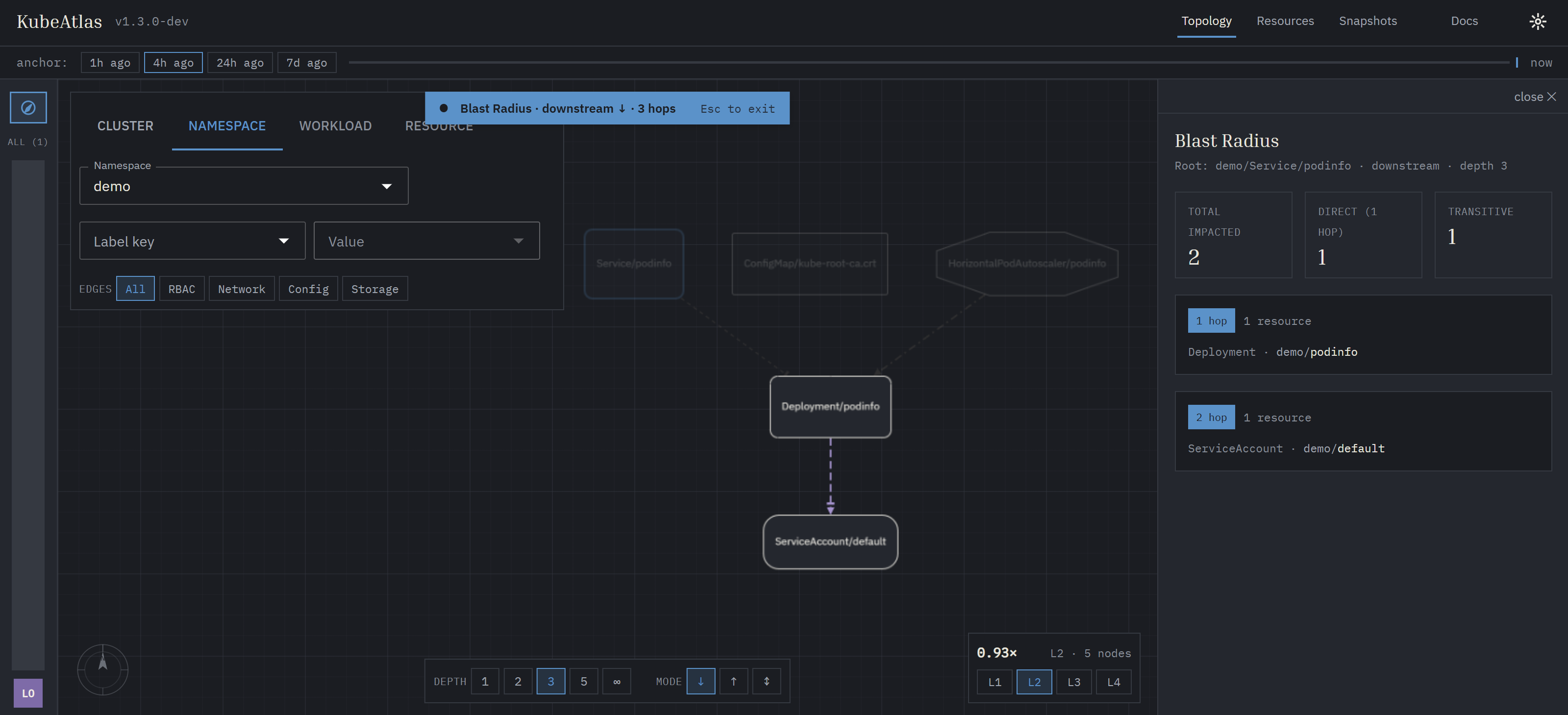
The Web UI surfaces this in the topology canvas: click any node, hit ↯ Show blast radius in the right panel (or right-click for the radial picker), and the canvas dims everything outside the reachable subgraph. The bottom toolbar lets you change depth (1 / 2 / 3 / 5 / ∞) and direction (↓ downstream, ↑ upstream, ↕ both) without leaving the mode; Esc returns to the normal canvas with your selection intact.
API
GET /api/v1/blast-radius/{namespace}/{kind}/{name}
Cluster-scoped resources use _ as the namespace (the same
sentinel the resource-detail endpoint uses).
curl 'http://127.0.0.1:8080/api/v1/blast-radius/petclinic/ConfigMap/db-config' | jq .
{
  "source":   { "kind": "ConfigMap", "namespace": "petclinic", "name": "db-config" },
  "affected": [
    { "kind": "Deployment", "namespace": "petclinic", "name": "api" },
    { "kind": "ReplicaSet", "namespace": "petclinic", "name": "api-7c4d" },
    { "kind": "Pod",        "namespace": "petclinic", "name": "api-7c4d-x2k9p" }
  ],
  "count": 3,
  "maxDepth": 5
}
Query parameters
| Param | Default | Notes |
|---|---|---|
max_depth | 5 | Path-length cap. Hard ceiling 10 — deeper graphs are almost always cyclic. |
edge_types | empty (any) | Comma-separated allowlist of edge labels to follow. Useful for "trace only OWNS" or "trace only USES_CONFIGMAP". |
include_source | false | Set to true to include the start resource itself in the result; useful when you want a single subgraph for rendering. |
What "incoming" means
KubeAtlas edges encode child → parent / consumer → resource direction:
| Edge | Direction | Reading |
|---|---|---|
OWNS | child → owner | Pod -OWNS-> ReplicaSet: "Pod is owned by ReplicaSet" |
USES_CONFIGMAP | consumer → ConfigMap | Deployment -USES_CONFIGMAP-> ConfigMap |
USES_SECRET | consumer → Secret | same shape |
BINDS_SUBJECT | binding → subject | RoleBinding -BINDS_SUBJECT-> ServiceAccount |
The BlastRadius query asks: who points at me? That is, follow
the arrows in reverse. So the blast radius of a ConfigMap is the
set of consumers; the blast radius of a Role is the set of
RoleBindings that bind it; and so on.
Algorithm
Tier 1 (in-memory): a BFS over the adjacency map keyed by to,
bounded by max_depth. Cost is O(V+E) over the reachable
sub-graph; for typical clusters this is sub-millisecond.
Tier 2 (PostgreSQL + Apache AGE): a recursive CTE on the plain
edges table — both directions share two fixed SQL strings,
which lets pgx's per-connection statement cache + Postgres'
plan cache reuse the work across calls. The AGE vertex / edge
mirror is still maintained by the double-write Upsert path
(future graph-pattern queries can use it); reads bypass AGE
because the recursive-CTE plan is well-trodden in Postgres and
the per-call cypher() parse cost otherwise dominated wall
time on short queries.
Both backends share the same Direction enum and the same
Traverse interface method, so semantics never drift between
tiers.
Both implementations use a UID-keyed visited set for de-duping — no marshal/unmarshal in the hot loop.
Folded into resource detail (/api/v1/...)
The v1 GA surface adds three enrichment fields to the resource-detail endpoint:
curl 'http://127.0.0.1:8080/api/v1/resources/petclinic/ConfigMap/db-config' | jq .
{
  "resource": { "...": "..." },
  "incoming": [],
  "outgoing": [],
  "blastRadiusCount": 3,
  "isOrphan": false,
  "inCycle": false
}
blastRadiusCount is a single integer — the same number the
explicit endpoint returns. The UI uses this to render a badge on
each resource row without a follow-up round-trip.
The v1alpha1 surface (/api/v1alpha1/...) intentionally does
not carry these fields; the Phase 1 byte shape is frozen — see
API versioning.
What blast radius does not tell you
- Whether the affected resources will actually break. A
Deployment that mounts a ConfigMap as
optional: truesurvives the ConfigMap going missing. The graph encodes the dependency, not the failure mode. - Anything about runtime traffic. The dependency is static (manifest-derived). For "what's actually receiving requests", pair this with a service-mesh / metrics tool.
- Custom-resource semantics that aren't in a rule pack. If your cluster has CRDs whose dependencies aren't covered by the built-in extractors or any loaded rule pack, those edges won't show up. See Rego rules for the extension point.
Performance budget
The playbook target for v1.0 is p95 < 500ms on a 5K-resource
cluster, both Tier 1 and Tier 2. The unit-test perf gate
(pkg/graph/analysis/cycles_test.go + the Tier 2 traverse
benchmark in pkg/store/postgres) keep both backends honest
during development. The capture-once baseline lives at
test/verify/perf-baseline-v1.0.json; CI does not run it on
every PR (cost), but bash test/perf/bench-v1.sh can be
triggered before any tag cut.