What is KubeAtlas
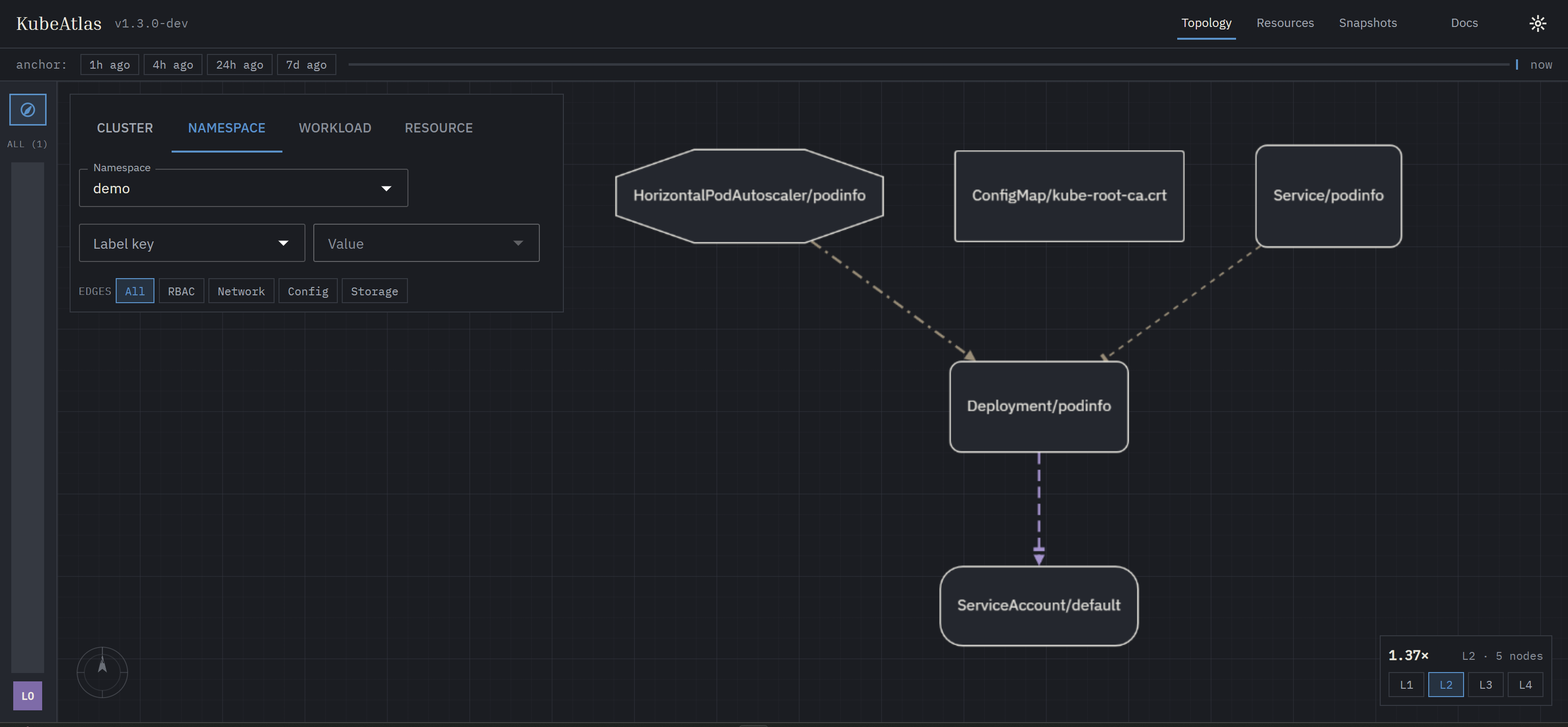
KubeAtlas builds a directed dependency graph of every resource in a
Kubernetes cluster — Deployments, ConfigMaps, Services, Ingresses,
Gateways, HTTPRoutes, PVCs, RBAC, CRDs — and lets you query it. It
answers the questions a flat kubectl get view cannot:
- "If I delete this Secret, what breaks?"
- "Which Deployments mount this ConfigMap?"
- "What's the routing path from this Ingress to a Pod?"
What it is not
- A general-purpose Kubernetes UI. Use Headlamp or Lens for that.
- A monitoring tool. Use Prometheus, Datadog, or your APM of choice.
- A GitOps tool. Use Argo CD or Flux.
KubeAtlas is the dependency graph: a focused view that complements the tools above instead of replacing them.
Project status
v1.5.2 release candidate. The dependency graph keeps Secret references but KubeAtlas no longer lists or watches Secret objects. Defensive inputs are reduced to reference-only nodes before rule evaluation or storage, existing Tier 2 Secret rows and historical event payloads are scrubbed during migration, and snapshot history is metadata-only for every resource. The production install command remains pinned to v1.5.1 until all v1.5.2 artifacts pass the release matrix.
v1.5.1. The v1.5.0 feature set is unchanged, but the Tier 2 installation and release lifecycle are hardened: CloudNativePG 0.22.1 is an explicit cluster-scoped prerequisite, the embedded PostgreSQL Cluster and its PVCs are retained on uninstall by default, and the release workflow publishes the pinned PostgreSQL + Apache AGE image before the Helm chart. Upgrade, database-recovery, uninstall-retention, and snapshot paths are enforced in CI.
v1.5.0. A non-breaking minor: an opt-in OpenTelemetry runtime
overlay (GET /api/v1/otel/overlay, Tier 2, observed
CALLS_AT_RUNTIME edges layered over the declarative graph);
read-side multi-cluster RBAC visibility (F-206) keyed on a hashed
bearer token, open when unconfigured; and an internal GraphStore v2
that surfaces graphstore_version on GET /api/v1/info while
leaving the public HTTP API unchanged and v1alpha1 frozen. A
Headlamp OTel Overlay view and the Backstage plugin at Headlamp
parity ship alongside.
v1.4.0. A self-contained offline diagnostic
report (kubeatlas diagnose, HTML/JSON, for air-gapped audits and
CI), policy visibility (Gatekeeper Constraints and Kyverno policies
surface as ENFORCES edges via runtime CRD discovery, with a new
Policy view), opt-in anonymous usage telemetry (off by default,
with a documented trust contract and a transparent
/api/v1/telemetry/preview), and per-version API usage counters
that begin tracking v1alpha1 vs v1 ahead of the v2.0 removal.
A Headlamp Policy view and a GitHub Action policy-report option
ship alongside.
v1.3.1 — federation cluster picker wired to the topology
canvas, keyboard graph traversal, drag-anchor time-axis rail,
radial menu for blast-radius depth, screen-reader announcements,
Slate theme WCAG AA contrast fix, and kubectl atlas --version.
v1.3.0. Multi-cluster federation (one
KubeAtlas instance attaches to N kubeconfigs and serves
/api/v1/federation/*), platform-identity edges
(BINDS_PLATFORM_IDENTITY for EKS IRSA / AKS Workload
Identity / GKE Workload Identity), HorizontalPodAutoscaler
support (new SCALES edge type), kubeatlas-action for GitHub
CI, and the cartography Web UI redesign (5 runtime-switchable
themes, ⌘K command palette, blast-radius mode, time-axis diff,
edge-type filter presets, multi-cluster left strip).
Carried forward from earlier phases: persistent state
(PostgreSQL + Apache AGE, opt-in), Rego rule packs, RBAC graph,
blast radius, orphan + cycle detection, /api/v1/* GA
alongside the frozen /api/v1alpha1/*, cert-manager TLS Helm
integration. Defaults stay the same as v0.1.0: in-memory unless
you opt in, single-replica, no built-in authentication — see
the security warning
before exposing the UI. The Quick Start
walks through the install; the Roadmap covers
what's next.
Reading order
- Quick Start — get a graph out of a cluster (any cluster you control; kind works if you don't have one) in a few minutes.
- Architecture — design principles and how the pieces fit together.
- Concepts — the conceptual model (blast radius, orphans + cycles, Rego rules, API versioning).
- Developer Guide — for contributors: prerequisites, build, test, and a worked example of adding an edge type.
- Roadmap — where KubeAtlas is going next.